NetSuite vs QuickBooks: Which ERP Is Right for Growing Companies?

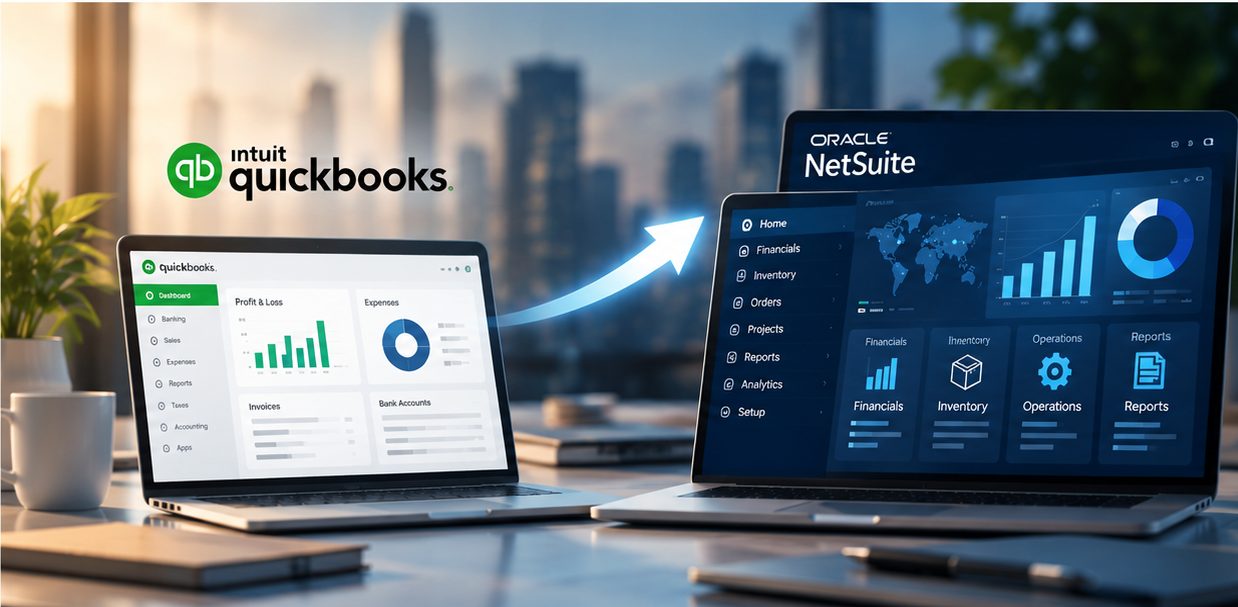
Choosing between QuickBooks and NetSuite is one of the most common decisions companies face as they grow.
At the early stages, QuickBooks is often the right choice. It’s simple, accessible, and effective for basic financial management.
However, as businesses scale, many start to experience limitations that impact operations, reporting, and decision-making.
Understanding when to transition — and what to expect — is key to making the right decision.
When QuickBooks Works Best
QuickBooks is designed for small to mid-sized businesses with relatively simple financial and operational needs.
It works well when:
- The company operates as a single entity
- Financial reporting requirements are straightforward
- There is limited need for operational integration
- Processes can be managed without advanced automation
For many companies in early growth stages, QuickBooks provides exactly what is needed.
When Companies Outgrow QuickBooks
As businesses expand, complexity increases.
Common signs that QuickBooks may no longer be sufficient include:
- Managing multiple entities or locations
- Difficulty consolidating financial data
- Heavy reliance on manual processes and spreadsheets
- Limited visibility into operations beyond accounting
- Challenges in scaling reporting and forecasting
At this stage, the system may begin to create friction rather than support growth.
What NetSuite Offers Growing Companies
NetSuite is a cloud-based ERP designed to support more complex business environments.
It provides:
- Multi-entity and multi-location management
- Integrated financials, inventory, and operations
- Advanced reporting and real-time visibility
- Workflow automation across departments
For companies in manufacturing, distribution, and other operationally complex industries, these capabilities become essential.
The Most Common Mistake After Switching to NetSuite
Many companies assume that moving to NetSuite will automatically solve their operational challenges.
However, the system’s effectiveness depends on how it is implemented and managed.
Without proper structure and optimization, companies may still experience:
- Performance issues
- Overcomplicated workflows
- Inefficient reporting
- Lack of adoption across teams
Switching systems without addressing underlying process issues often leads to similar frustrations.
NetSuite vs QuickBooks: It’s Not About Which Is Better
The decision is not about choosing the “best” ERP.
It’s about choosing the system that aligns with your current stage of growth and operational needs.
QuickBooks is ideal for simplicity.
NetSuite is designed for scalability.
The key is knowing when your business has reached the point where simplicity is no longer enough.
Final Insight
Many companies delay moving beyond QuickBooks until operational challenges become too significant to ignore.
Evaluating your current system — and whether it supports your growth — is an important step in avoiding future inefficiencies.
If your business is starting to outgrow its current system, evaluating your ERP strategy can help you understand whether it’s time to scale, and how to do it effectively.